FAQPage Structured Data: Schema.org Syntax & Google's Current Display Status
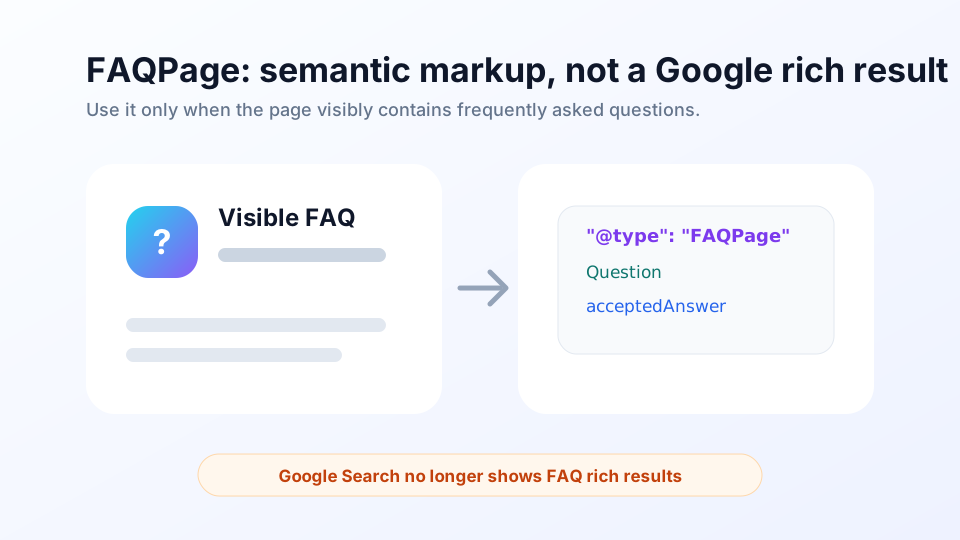
FAQPage was once a structured data type SEO circles loved, because it could show collapsible Q&A in Google search results. But that premise has changed: Google announced in May 2026 that FAQ rich results would no longer be shown, and removed the FAQ rich result documentation in June 2026. So this article won't teach you to "win FAQ rich result display"—instead, it explains how to use FAQPage correctly as a Schema.org semantic marker, and whether it's still worth doing.
Current Status: Google No Longer Shows FAQ Rich Results#
As of June 2026, Google's official changelog explicitly states: the FAQ rich result feature no longer appears in Google search results, and the related documentation has been removed. This means:
- FAQPage should no longer be treated as an SEO tactic for "winning Google collapsible Q&A results."
- Rich Results Test and Search Console's support status for FAQ may differ from the past.
- If the page already has genuine FAQs, you can still describe them with Schema.org's
FAQPage, but the goal should be semantic clarity, not chasing extra search-result real estate.
What Is FAQPage#
Schema.org defines FAQPage as: a page that presents one or more frequently asked questions. Typical scenarios include:
- A product or service help center's FAQ page;
- An "FAQ" block at the end of a tutorial article;
- Pages explaining policies, pricing, shipping, returns;
- Rule Q&A on an event registration page.
The core requirement remains matching visible content: every question and answer in the JSON-LD should be something the user can see on the page.
FAQPage vs QAPage#
| Type | Suitable Scenario | Answer Source | Don't Use For |
|---|---|---|---|
FAQPage | A set of FAQs compiled by the site itself | Official/editorial answers | Open user-discussion pages |
QAPage | A question page with multiple user answers | User/community answers | Static help docs and tutorial-end FAQs |
If the page is "one question + multiple user answers + possibly voting or a best answer," that's closer to QAPage. FAQPage is better suited to standard answers the site itself provides.
Complete JSON-LD Example#
Below is a Schema.org FAQPage example. Note: this isn't code that guarantees a Google rich result—it describes genuinely visible FAQ content on the page.
<script type="application/ld+json">
{
  "@context": "https://schema.org",
  "@type": "FAQPage",
  "mainEntity": [
    {
      "@type": "Question",
      "name": "Does structured data always bring rich results?",
      "acceptedAnswer": {
        "@type": "Answer",
        "text": "No. Structured data only helps search engines understand the page; whether a rich result is shown is decided by Google based on feature support, page quality, policy, and search context."
      }
    },
    {
      "@type": "Question",
      "name": "Can FAQPage mark up questions not shown on the page?",
      "acceptedAnswer": {
        "@type": "Answer",
        "text": "No. Structured data must match the page's visible content; you can't sneak in questions and answers the user can't see."
      }
    }
  ]
}
</script>
Understanding the Fields#
| Field | Meaning | How to Write |
|---|---|---|
FAQPage | The current page is an FAQ page or contains an FAQ | As the top-level object |
mainEntity | The page's main Q&A list | An array containing multiple Questions |
Question.name | The question text | Matches the page's visible question |
acceptedAnswer | The official answer | An Answer object |
Answer.text | The answer content | Matches the page's visible answer; may include necessary HTML |
When Is It Still Worth Using#
To judge whether FAQPage is worth doing now, use this priority:
- The page genuinely needs an FAQ: Users actually have recurring questions, and an FAQ reduces comprehension cost.
- High Q&A quality: Answers are specific, accurate, verifiable—not marketing boilerplate.
- Low template generation cost: An existing article template can auto-sync the end-of-article FAQ and the JSON-LD.
- Not for Google display: Even if Google doesn't show FAQ rich results, the page itself still has value.
If you're just stuffing every page with an FAQ to "take up more search-result space," there's no need anymore.
How This Page Demonstrates It#
This page has four visible FAQs at the end, and the page source also has a FAQPage JSON-LD block—matching one to one. This site keeps this markup to fully demonstrate Schema.org semantic syntax, not to promise Google will show an FAQ rich result.
How to Validate#
- Validate the Schema.org syntax with the Schema Markup Validator.
- Check that the page's visible FAQ matches the
mainEntityin the JSON-LD item by item. - Don't use whether FAQPage appears in the Google rich results report as a success criterion anymore.
- Keep Search Console monitoring, but focus more on page indexing, CTR, and user behavior than on FAQ display.
Common Mistakes#
| Mistake | Why It's Wrong | Fix |
|---|---|---|
| Still promising FAQ rich result display | Google has removed that feature | Reframe as semantic markup and content structure |
| Marking up questions not on the page | Violates the match-visible-content principle | Only mark up FAQs users can see |
| Marking forum Q&A as FAQPage | Type mismatch | Consider QAPage for user-answer pages |
| Stuffing boilerplate FAQs on every page | Low value, duplicate, unhelpful to users | Keep only genuine high-frequency questions |
| Overly marketing answers | Doesn't solve the problem, lowers trust | Answer directly first, then give necessary links |
| JSON-LD out of sync with the end-of-article FAQ | Inconsistent signals | Generate the visible FAQ and the markup from one content source |
FAQPage Launch Checklist#
- The page genuinely has user-visible FAQ content
- FAQPage isn't treated as a Google rich-result growth tactic
- Each Question.name matches the page's question
- Each acceptedAnswer.text matches the page's answer
- FAQs are official site answers, not user discussions
- No hidden, fabricated, duplicate, or marketing Q&A marked up
- Syntax validated with the Schema Markup Validator
- The page stays centered on content quality and helping users
- Periodically re-check Google structured data policy changes
Frequently Asked Questions#
Can FAQPage still earn Google rich results now?
As of June 2026, Google has removed the FAQ rich result feature and related documentation, stating that FAQ rich results no longer appear in Google search results. Therefore, you should no longer treat FAQPage as a way to win Google's collapsible Q&A display. It can still be used as a Schema.org semantic marker to describe genuinely visible FAQ content on the page.
What's the difference between FAQPage and QAPage?
FAQPage suits a site providing its own set of questions and official answers, such as product help pages, policy explanations, or an FAQ at the end of a tutorial. QAPage suits a question page with multiple user answers, voting, or interaction, such as forums and Q&A communities. Don't mistakenly mark up a user-discussion page as FAQPage.
Can I add FAQPage if the page only has a few FAQs at the end?
Yes, provided the Q&A is visible to users, directly relevant to the page topic, the answers are provided by the site, and the content is genuine. Don't mass-produce duplicate, marketing-style, or nonexistent questions just for structured data.
Is it still worth keeping FAQPage markup?
If the page genuinely has high-quality, visible FAQs, keeping the FAQPage semantic markup is fine—but don't make it a priority for earning Google search rich results. Its priority should be lower than types that still have clear Google search uses, such as Article, BreadcrumbList, Product, and Review.